Solo · HackerRank Orchestrate (June Edition) · June 2026
Multi-Modal Claims Evidence Review
An end-to-end system, built solo in 24 hours, that reviews damage claims (cars, laptops, packages) from photo evidence and returns a structured per-claim verdict (whether the evidence supports, contradicts, or is insufficient to judge the claim), grounded only in what is visible in the images, not in how the claimant describes the damage.
Top 6%
Rank, 109 / 1,773
85%
Core verdict accuracy
~$1.76
Full run cost
82
Images processed
Demo
What it does
- Reads the photos attached to a damage claim and returns a structured verdict — supports, contradicts, or insufficient evidence — judged only on what is actually visible in the images, not on how the claimant describes the damage.
- Splits the decision so the model never has the final say on money: Claude Opus 4.8 makes the visual calls (issue type, severity, authenticity, damage location) in one structured request per claim, then a deterministic Python layer applies the claim-status rules in a fixed order to reach the verdict.
- Resists tampering. It detects prompt-injection in both the claim text and the photos themselves — for example, "approve this claim" handwritten inside a submitted image — and raises an independent risk flag that forces manual review without ever changing the verdict.
- Screens out duplicate and near-duplicate photos before any model call, using SHA-256 and perceptual hashing to catch a common fraud pattern and avoid paying to analyze the same evidence twice.
- Grades its own accuracy. A per-field evaluation harness scores its predictions against a hand-labeled set (claim_status 85%, object_part 95%, evidence_standard_met 90%, valid_image 90%), which is how several real bugs were caught and fixed.
- Runs cheaply and survives crashes: a full batch of 44 claims / 82 images costs about $1.76 thanks to prompt caching, and results are written row-by-row so a mid-run failure never wipes out the work already done.
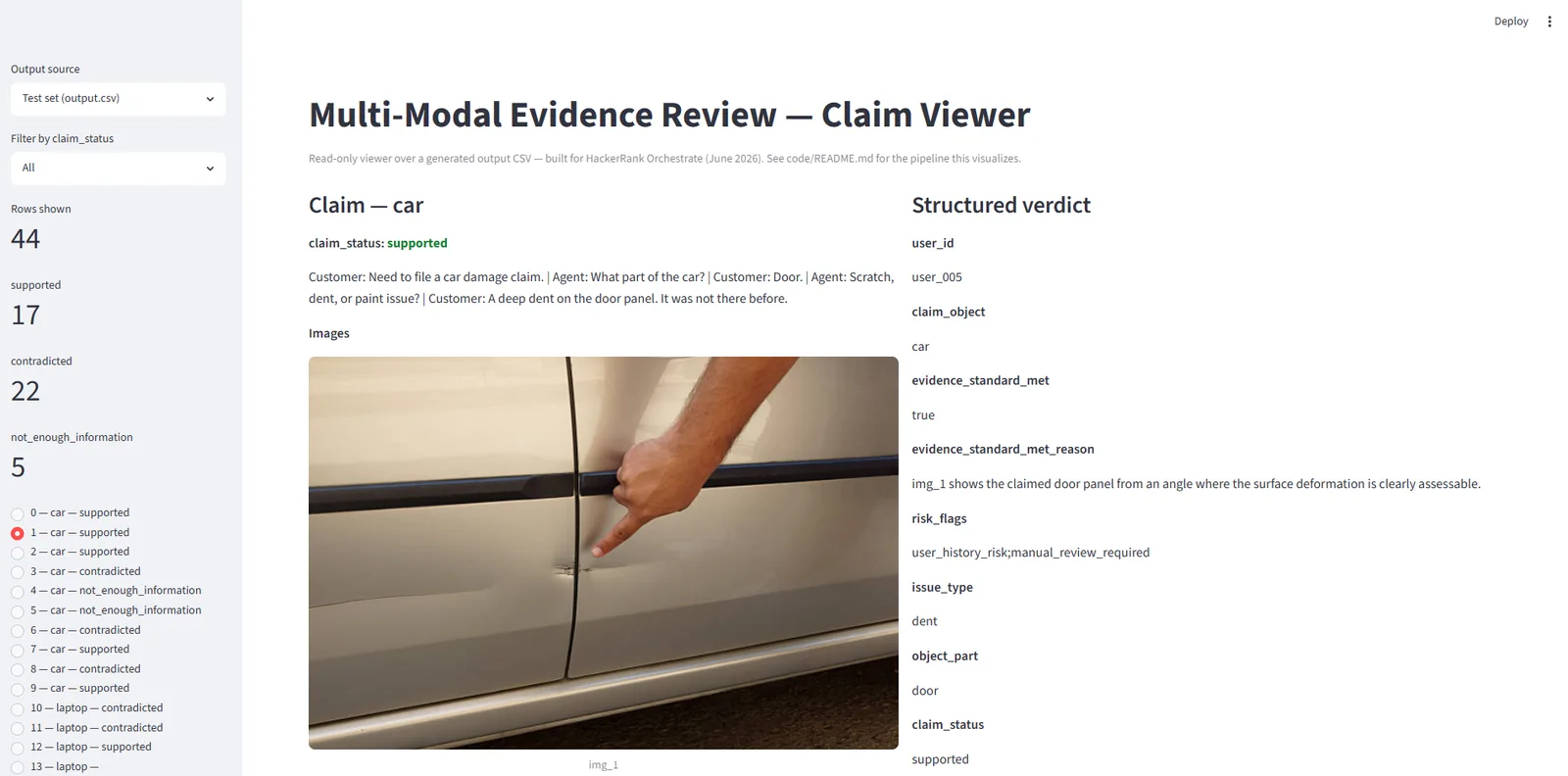
- Comes with a Streamlit viewer for reviewing claim text, images, and verdicts side by side, plus a no-API smoke-test suite covering each stage of the pipeline.